
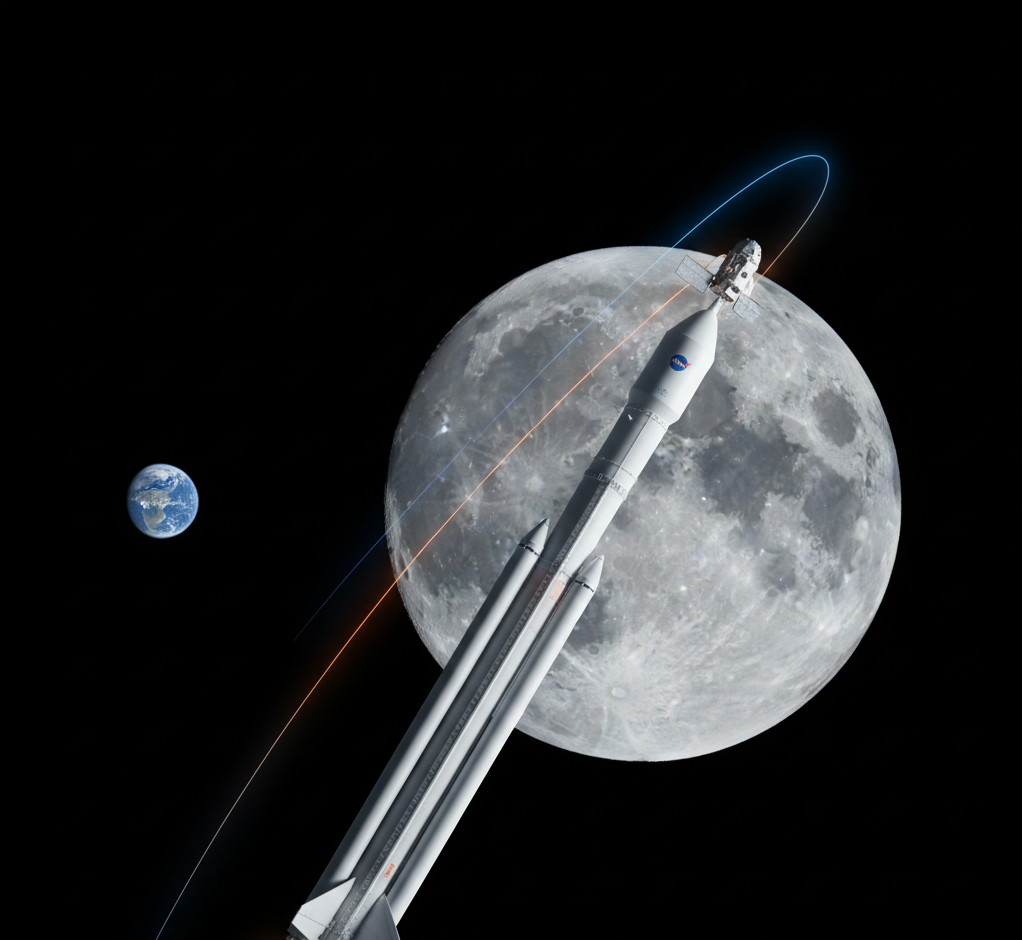
The NASA Artemis program represents the boldest era of deep-space exploration since the Apollo missions. With the upcoming launch of Artemis II, NASA is set to send four astronauts on a historic journey around the Moon, marking the first time humans have ventured beyond low-Earth orbit (LEO) in over five decades.
This mission is not just a return to the Moon; it is the fundamental "proving ground" for sustainable lunar habitation and the eventual human exploration of Mars.
Artemis II: Mission Overview and Launch Status
Artemis II is the first crewed flight test of NASA’s Space Launch System (SLS) rocket and the Orion spacecraft. Following the successful uncrewed Artemis I mission in 2022, this 10-day flight will validate that all of Orion’s life-support systems are ready to sustain astronauts in the harsh environment of deep space.

Current Launch Timeline (As of February 2026)
Following a recent wet dress rehearsal at Kennedy Space Center, NASA has adjusted the launch schedule to ensure maximum safety.
- Target Launch Window: March 2026 (Earliest opportunities March 6–9 and March 11).
- Backup Windows: April 2026.
- Launch Site: Launch Complex 39B, Kennedy Space Center, Florida.
Technical Specifications: The SLS and Orion
The Artemis missions rely on the most powerful rocket ever built and a spacecraft designed for high-velocity reentry.
The Space Launch System (SLS)
The SLS Block 1 configuration provides the massive thrust required to propel Orion into a Trans-Lunar Injection (TLI).
- Height: 322 feet (98 meters).
- Thrust: 8.8 million pounds at liftoff (15% more than the Saturn V).
- Core Stage: Powered by four RS-25 engines burning liquid hydrogen and liquid oxygen.
The Orion Spacecraft
Orion serves as the command module for the crew. It consists of the Crew Module (habitable area) and the European Service Module (propulsion and life support provided by ESA).
- Reentry Speed: Up to 24,500 mph (Mach 33).
- Radiation Protection: Enhanced shielding to protect the crew from solar flares and cosmic rays.
Mission Objectives and Flight Path
Artemis II will follow a Hybrid Free-Return Trajectory. This profile ensures that if the engines fail, the Moon’s gravity will naturally pull the spacecraft back toward Earth.
- Launch & Earth Orbit: Orion will spend 24 hours in high-Earth orbit to test life-support and proximity operations.
- Trans-Lunar Injection: The upper stage (ICPS) fires to send Orion toward the Moon.
- Lunar Flyby: The crew will travel roughly 4,700 miles beyond the lunar far side—the farthest humans have ever traveled into space.
- Splashdown: Orion will perform a "skip reentry" to bleed off heat before splashing down in the Pacific Ocean.
The Artemis Program: Goals and Future Implications
The overarching goal of the Artemis program is to establish a permanent human presence on the Moon. This is achieved through three primary pillars:
- The Lunar Gateway: A small space station in lunar orbit that will serve as a communication hub and staging point for surface missions.
- Artemis Base Camp: Proposed lunar south pole infrastructure featuring a cabin, rover, and mobile home.
- International Cooperation: The Artemis Accords unite dozens of nations in a shared framework for peaceful, transparent lunar exploration.
The Bridge to Mars
NASA views the Moon as a "test bed" for Mars. Technologies developed for the Moon—such as autonomous power systems, water ice extraction (In-Situ Resource Utilization), and advanced radiation shielding—will be critical for the 2-year round-trip journey to the Red Planet.
FAQ: NASA Artemis Rocket Launch
Who is the crew of Artemis II? The crew includes Commander Reid Wiseman, Pilot Victor Glover, Mission Specialist Christina Koch (NASA), and Mission Specialist Jeremy Hansen (CSA).
When will humans land on the Moon again? The Artemis III mission, currently targeted for late 2027 or 2028, intends to land the first woman and first person of color on the lunar south pole.
Why is NASA going to the Lunar South Pole? The south pole contains water ice in permanently shadowed craters. This ice can be harvested for drinking water, oxygen, and even rocket fuel (hydrogen and oxygen).
Would you like me to generate a detailed breakdown of the scientific experiments the crew will conduct during their 10 days in orbit?
This Artemis II mission overview provides a visual walkthrough of the flight profile and the critical systems being tested during this historic crewed flyby.


